


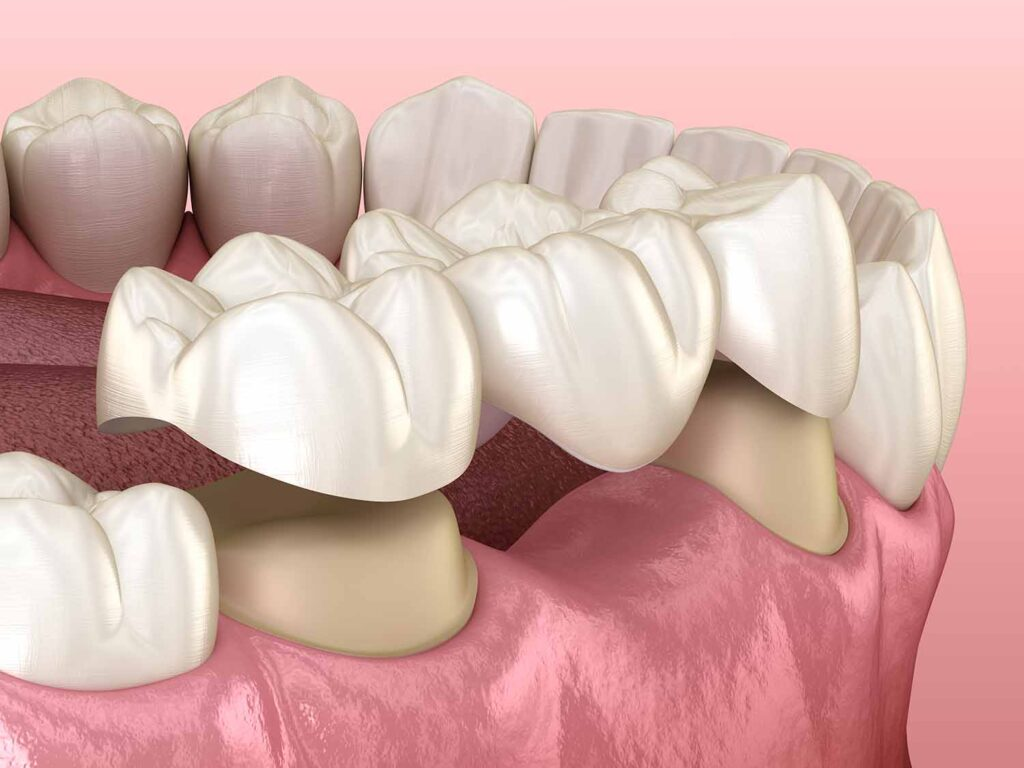
Learn what a dental bridge is, how it works, the different types available, and whether it’s the right solution to restore your smile.
Losing a tooth doesn’t just leave a gap in your smile. It also affects how your bite functions.
Chewing becomes uneven. Neighbouring teeth begin to shift. The tooth above or below the gap can start to drift into the space because it no longer has anything to bite against.
This is where a dental bridge becomes more than a cosmetic solution. It keeps the teeth around the gap where they belong.
Dr. Wong often explains that teeth are designed to work together. When one is missing, the system adapts, and not always in healthy ways. Replacing it early helps protect long-term stability.
A bridge is one of three ways to replace a missing tooth for the long term, alongside dental implants and removable dentures. Let’s walk through what a dental bridge actually is, how it works, and when it makes sense.
What Is a Dental Bridge?
A dental bridge is a fixed restoration (i.e., it does not come in and out of the mouth) that replaces one or more missing teeth by anchoring to neighbouring teeth or dental implants. Think of a bridge on a road: a span supported at both ends. The replacement tooth sits in the gap, and the teeth on either side hold it up.
It consists of:
- Abutment teeth (the supporting teeth or implants)
- Pontic (the replacement tooth that fills the gap)
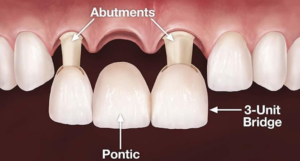
Once cemented in place, the bridge works much like a natural tooth. It restores chewing and keeps the neighbouring teeth from drifting. It cannot be taken out at home. Unlike removable dentures, dental bridges stay in place.
A well-designed bridge should feel natural, not like something you are constantly aware of.
Why Is a Dental Bridge Needed?
When a tooth is missing, several things begin happening quietly:
- Adjacent teeth tilt toward the space
- The tooth above or below the gap moves into the space, which dentists call over-eruption
- Bite pressure becomes uneven
- Food traps become more common
- Jaw strain may increase if teeth no longer meet properly
The gap itself can also shrink as teeth drift. In one bridge case from our office, the space had narrowed so far that there was no longer room for an implant, which made a bridge the better choice.
Patients often adapt at first. They chew on the other side. They avoid certain foods. But over time, compensation creates stress elsewhere.
Dr. Wong frequently tells patients that replacing a tooth is not just about filling a space; it’s about preventing a chain reaction.
Types of Dental Bridges
There are several types of dental bridges, and choosing the right one depends on location, bite forces, and overall oral health.
Traditional Dental Bridge
This is the most common dental bridge design. The teeth on either side of the gap are reshaped and fitted with crowns. The artificial tooth connects them. In practice, that means taking roughly 1.5 mm off the top of each supporting tooth and about 1 mm around the sides, so the finished bridge is no bulkier than the original teeth. This option works very well when adjacent teeth already require crowns or have large fillings. It’s strong, reliable, and widely used.
Cantilever Dental Bridge
Used when support exists on only one side of the missing tooth.
Because it places force on a single abutment tooth, it’s used selectively and often in areas with lighter bite pressure. Cantilever bridges have a poor track record in back teeth. The incisors are the main exception, and even there the bite against them needs to be light.
Dr. Wong evaluates carefully before recommending this option.
Maryland (Resin-Bonded) Dental Bridge
Often chosen for front teeth. Instead of full crowns, it uses thin “wings” bonded to the back of the neighbouring teeth. That makes it more conservative, but it is not built for heavy chewing.
The traditional metal-winged version has two common problems. The metal can make the front teeth look grey, and one wing can come loose while the other stays in place. In one case from our office, we replaced exactly that with two all-ceramic bridges. The grey was gone, and the patient could floss normally again (check out these before and after photos).
Implant-Supported Dental Bridge
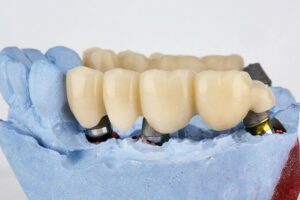
Rather than relying on natural teeth, this design attaches pontics to dental implants.
Dr. Wong recommends implant-supported bridges when multiple teeth are missing and bone health is adequate.
They offer excellent stability and help preserve jawbone structure.
What Is a Dental Bridge Made Of?
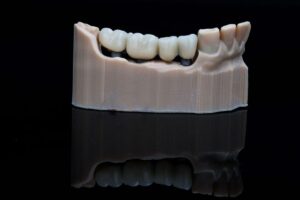
Material choice affects aesthetics, durability, and longevity.
The four main options are:
- Porcelain
- Porcelain-fused-to-metal
- Zirconia
- Metal
Porcelain Dental Bridges
Porcelain provides a highly natural appearance. It reflects light similarly to enamel, making it ideal for visible areas.
For patients concerned about aesthetics, porcelain is often preferred. Glass ceramic, a close relative, is what we used for the front-tooth case described above but sparingly, as zirconia bridges are preferred.
Porcelain-Fused-to-Metal Bridges
These combine the strength of a metal substructure and the aesthetics of porcelain. The internal metal framework adds durability, while the porcelain exterior maintains a natural look.
They have been used successfully for decades. It is the type used in the bridge case we documented step by step.
Zirconia Dental Bridges
Zirconia is very strong, and modern zirconia can look natural.
It is often chosen in areas where strength and longevity are priorities, especially for patients with heavier bite forces.
Metal (gold) Dental Bridges
Used less frequently today for visible areas, but still applicable in specific posterior cases.
Material selection is not one-size-fits-all. Dr. Wong considers bite force, location, gum health, and long-term goals before recommending an option.
Dental Bridge Procedure Step by Step
The dental bridge procedure typically involves two visits, about two weeks apart, while the bridge is made in a dental laboratory.
Visit 1: Preparation
- Examination and imaging
- Freezing, then reshaping the supporting teeth so they are parallel to each other, which lets the bridge slide in as one piece.
- Impressions of the reshaped teeth, which go to a dental laboratory so the bridge can be made to fit them exactly. Typically, this is now achieved via a digital scan.
- A temporary bridge, held on with a weak cement so it comes off easily at the next visit.
Visit 2: Final Placement
- Fit verification
- Bite adjustment
- Cementing or bonding the final bridge in place
Dr. Wong takes time ensuring the bite feels correct before final cementation. Precision here prevents long-term discomfort.
How Long Does a Dental Bridge Last?
Many bridges last 10 to 15 years, and often longer with good care. No bridge is permanent, though, and nobody can promise a set number of years.
Longevity depends on:
- Oral hygiene
- Bite alignment and the presence of grinding habits
- Material used
- Routine dental visits
- Whether the supporting teeth have had a root canal. Bridges tend to last longer when they have not
A bridge is not expected to last as long as an implant, which matters when you compare the two on cost.
Benefits of a Dental Bridge
A dental bridge offers:
- Restored chewing ability
- Improved speech clarity over a partial denture
- Aesthetic improvement
- Bite stabilization
- Prevention of shifting teeth
It is also much quicker than an implant: weeks rather than months, because there is no bone healing or bone grafting to wait for. And because it is fixed, it cannot slip or come loose the way a removable partial denture can.
For many patients, the psychological benefit matters too. Being able to smile without thinking about the gap makes a real difference.
Risks and Disadvantages of Dental Bridges
No solution is perfect. Considerations include:
- The supporting teeth have to be cut down, even when they are healthy. Occasionally the nerve does not tolerate this, and the tooth then needs a root canal to save it.
- The teeth are tied together. If one supporting tooth develops decay or the porcelain fractures, the whole bridge may need replacing
- Possible wear over time
- Cleaning takes extra effort, because floss has to be threaded under the replacement tooth. Skip it, and the supporting teeth can decay.
- Does not preserve bone as implants do
Dr. Wong presents balanced information so patients can make informed decisions.
Dental Bridge vs Dental Implant
The discussion around dental bridge vs implant is common.
Which Is Better: A Dental Bridge or an Implant?
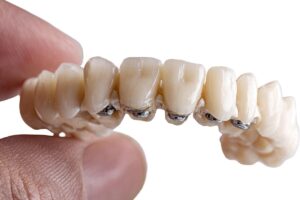
A bridge may be better when:
- Adjacent teeth already require crowns
- Surgery is not preferred
- The treatment timeline needs to be shorter
- There is not enough bone or space for an implant, or a medical history that could interfere with implant healing.
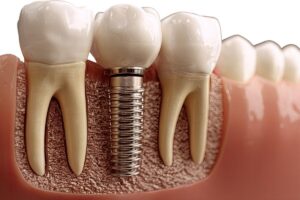
An implant may be better when:
- Adjacent teeth are healthy and untouched
- Bone preservation is important
- A single-tooth solution is desired
There is no universal “best.” There is only what fits your case.
A Note from Dr. Wong:
Implants and bridges are both great options for replacing teeth, and it’s important to be able to evaluate which is the better option in any particular situation. The more dentistry has experience with implants, the more we are aware of their limitations. Bridges have come back into favour much more in the last few years!
Here’s my approach: if any tooth needs replacement, an implant is still my first choice because it doesn’t tie one tooth to another. However, if aesthetics is crucial, or there are technical issues such as bone/tissue quantity concerns, we are not at all shy about presenting a bridge as the best option. Plus, doing a bridge still leaves open the option of placing an implant in the future.
If we’re talking about implant-supported bridges, those are a good way to replace multiple teeth without having to place one implant per missing tooth. In fact, a frequently used solution is to have six to eight implants support an entire arch of teeth. Commonly called an all-on-X solution, where X is the number of implants, these bridges can restore a far better experience of chewing and aesthetics than the removable denture alternative.
NOTE: not a quote about the practice being advanced, experienced or leading. RCDSO prohibits claims of superiority.
Cost Comparison Between Bridge and Implant
A dental bridge cost is generally lower initially.
Implants often involve a higher upfront cost but may last longer.
Over the long term, that can flip. A bridge is expected to need replacing sooner than an implant, and each replacement involves the same supporting teeth again, so a bridge can end up costing more over time.
Long-term value depends on oral health, maintenance, and individual circumstances.
Who Is a Good Candidate for a Dental Bridge?
You may be a candidate if:
- You have one or more missing teeth
- Adjacent teeth can support crowns
- Gum health is stable
- You maintain good oral hygiene
A bridge is also often the right choice when an implant is not possible because of limited bone, limited space or a medical reason.
Dr. Wong evaluates the entire bite, not just the gap.
How to Care for a Dental Bridge
Proper maintenance extends lifespan.
Oral Hygiene Tips for Dental Bridges
- Brush twice daily
- Use floss threaders, interdental brushes, or water flossers to clean under the bridge.
- Attend regular hygiene appointments.
Cleaning under the replacement tooth is the step people most often skip, and it is what protects the gum and the supporting teeth from decay. More on everyday care is on our preventive dentistry page.
Foods to Avoid With a Dental Bridge
Avoid:
- Ice chewing
- Chewing bones
- Opening packages with teeth or using teeth as tools for non-food items
Strong does not mean indestructible.
Dental Bridge Cost
Costs vary depending on complexity. There is no single price for a bridge, and we do not quote one before an examination. You get a written estimate once we have looked at the teeth involved and taken X-rays.
Dental Bridge Cost in Barrie
The cost of a dental bridge depends on:
- Number of teeth replaced
- Type of bridge
- Materials used
- Additional procedures to prepare tissues before the bridge
Ask your insurer for a predetermination before treatment starts, so you know what your plan will contribute.
Factors Affecting Dental Bridge Cost
- Porcelain vs zirconia
- Implant-supported vs traditional
- The laboratory work involved
- Any treatment needed first, such as treating decay or a root canal on a supporting tooth
Dental Bridge Treatment Near You

If you live in Barrie or Mapleview West, a personalized evaluation matters.
Dental Bridge Treatment in Barrie
At Dr. Elston Wong Dentistry, patients receive carefully planned restorative care.
Dr. Elston Wong emphasizes long-term stability, not temporary fixes. Each dental bridge is designed with balance, function, and aesthetics in mind.
Finding a Dentist for a Dental Bridge Near You
Patients benefit from comprehensive treatment planning and coordinated follow-up. Dr. Wong believes replacing a tooth should strengthen the entire bite, not simply fill space.
Dr. Elston Wong Dentistry is at 222 Mapleview Dr. W, Units 1 and 2, in Barrie. Call 705‑721‑1143 or book an assessment through our contact page.
Frequently Asked Questions About Dental Bridges
Is Getting a Dental Bridge Painful?
The procedure is performed under local anesthesia and is generally well tolerated. Expect some sensitivity in the supporting teeth for a few days afterward. If dental appointments make you anxious, tell us at the start. Sedation is available.
How Many Teeth Can a Dental Bridge Replace?
Bridges can replace one or multiple missing teeth, depending on support. The longer the span, the more load each supporting tooth carries, so a long gap may need more supports, or implants instead.
Can a Dental Bridge Be Removed?
Traditional bridges are fixed and not removable by the patient. They are cemented in place, and if one ever needs replacing, the dentist cuts it off.
What Is the Best Type of Dental Bridge?
The best type depends on oral health, location, and bite forces. A traditional bridge suits most back teeth, a Maryland bridge can work for a front tooth with a light bite, and an implant-supported bridge suits several missing teeth where the bone allows.
Does Insurance Cover Dental Bridges?
Many plans offer partial coverage. Most private plans pay a percentage of the fee up to an annual maximum, and a bridge can use up much of that maximum. Ask your insurer for a predetermination in writing before treatment begins.