



Dentures at Dr. Elston Wong Dentistry
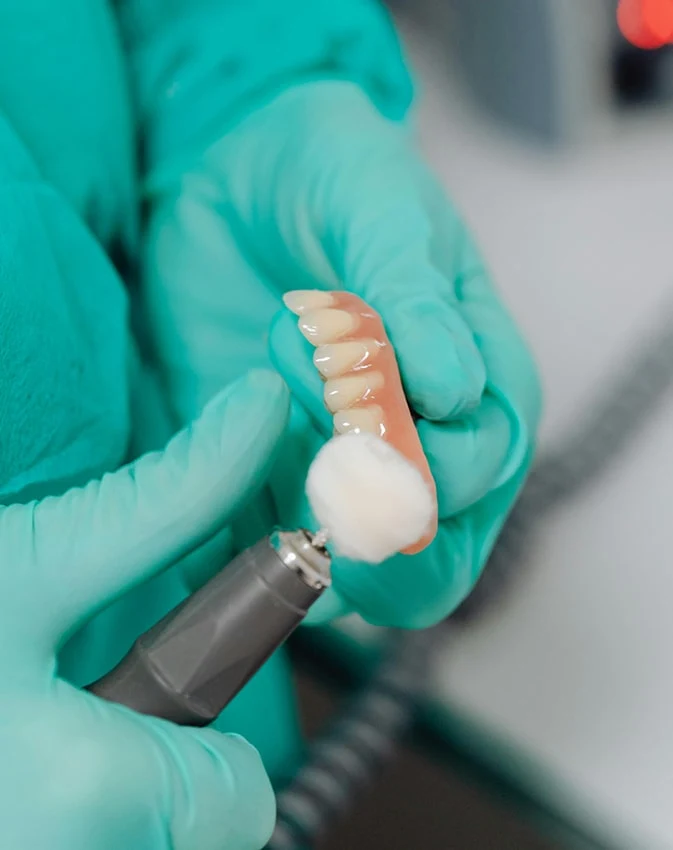

Complete and Partial Removable dentures
Replacement of missing teeth can be done in three basic ways: implants, bridges, and dentures. In certain situations, dentures make the most sense. These are removable prostheses that can replace one, some, or all of the teeth in an arch.
Complete dentures are used when all teeth are missing, while partial dentures replace one or more missing teeth while preserving remaining natural teeth.
If remaining teeth are used as support for the denture, we first ensure that they are in good health before fabricating the denture.
Like everything else, there are often many solutions for every situation, and it takes a careful evaluation to find what is best for you. What works for one person may not be the best for another.
Fast facts

Dentures are often one of the most affordable options for replacing multiple missing teeth.
Properly done, dentures can look surprisingly lifelike.
Dental implants are often used to make dentures much more secure.
Dentures require diligent hygiene to ensure that the supporting teeth or tissues remain healthy.
The process

Step One
We work with you to create a vision for your final result with photographs, study models, and a good discussion. We ensure we have clarity on your preferred aesthetics (colour, size, tooth shape) and functional requirements (your expected chewing experience).

Step Two
Think of making dentures like making a custom-made garment. There are measuring and fitting steps required to ensure that the final result is consistent with the original vision. By breaking down the steps, there is opportunity for your input along the way.

Step Three
Delivery! The denture is placed and a new journey begins! Learning how to chew with dentures in place, fine tuning any fit issues, ensuring proper cleaning and maintenance are all part of the denture process.
Let the results speak for themselves
Looking for real life transformations? Take a look at some before and after examples.
See our other restorative
dentistry services
Try our virtual smile simulation
Dentures FAQs
What are the effects when a tooth is lost?
Any time a tooth is lost, you can think of it as losing the use of two teeth – the one that is lost as well as the opposing tooth. The teeth adjacent to the space begin to drift into the space, the opposing tooth can move towards the space, causing tooth malalignment. Furthermore, the loss of any tooth will result in gradual (and sometimes rapid) loss of the supporting bone. This becomes an issue for implants if too much bone is lost – complicated and costly grafting is the only way to regenerate lost bone, and is never as good as the real thing.
Does my insurance cover dentures?
It really depends on the details of your insurance policy, and we can help you find out by submitting the required paperwork. Typically, insurances will cover a portion of the total cost but not all. Why? Don’t forget why insurance companies are in this game – they know that if they only cover a portion of the denture, a certain percentage of their policyholders will not want to pay for the rest. This means that they end up not having to pay for any of the denture! Insurance company benefits are best thought of as coupons, and certainly not guides to how you should look after your teeth.
What are the benefits of dentures?
Dentures are an economical, simple method of replacing many missing teeth at once. They are also versatile: they can act as spaceholders for future bridges or implants, and they can also serve as temporary “test drive” teeth to give you an idea of how you could look and function with a new setup of teeth.
How are dentures different from implants or bridges?
The big difference is that dentures are removable, meaning they can come in and out of the mouth. Given that there is more surface area to a denture than implants or bridges, there is more opportunity for food and plaque to lodge. Denture-wearers need to maintain diligent hygiene measures to keep their mouths healthy and decay-free. The dentures themselves need to be removed as much as possible for hygiene and to enable the mouth tissues to rebound from the pressure of the dentures.
What are dentures made of?
Dentures – once a boring topic where nothing much changes – are now the subject of many exciting changes. Once made with pink acrylic bases and advanced durable plastic teeth, now we have dentures that are made with flexible pink bases, and 3D printed dentures. On top of that, facial scanning technologies are making denture fabrication simpler and faster!
Are there different types of dentures?
Aside from the basic division of complete and partial dentures, there are many different styles and materials of dentures. All of these are customized to your individual situation. When dental implants are involved as well, dentures can become much more stable, tighter, less visible, and smaller! These hybrid-type solutions are great options where people wish to have something more stable but not incur the cost of an implant fixed (nonremovable) bridge.

What Our Patients Say
See what patients in Barrie are saying about their experience with Dr. Elston Wong Dentistry.
Barrie, ON L4N 9E7