


A tooth hurts for a week, and then the pain stops. Most people take that as a sign the problem has sorted itself out. Sometimes it means the opposite: the nerve inside the tooth has died, and the ache went with it.
That’s one of several ways people end up needing root canal treatment without ever suspecting it, and it’s why we diagnose it with an examination and an X-ray, not only by how the tooth feels. Root canal treatment removes the damaged tissue from inside a tooth so the tooth itself can stay.
So how do you know if you need one, and what are you actually signing up for? Read on. We’ll talk about the warning signs, what happens in the chair, what recovery is really like, and why the tooth still needs a crown afterward. We’ll also get into cost, including what the Canadian Dental Care Plan covers.
How a Healthy Tooth Works
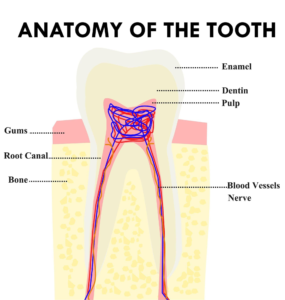
A tooth is built in three layers with living tissue at the centre.
- Enamel. The hard outer shell. No nerve supply, which is why early damage to it is painless.
- Dentin. Softer, underneath the enamel, threaded with microscopic tubules running inward.
- Pulp. The living core. Nerves and blood vessels, running down the inside of each root through narrow channels called root canals.
Most patients are never told this, but once a tooth has finished forming, the tissue inside it is no longer needed to make the tooth work. Most of what you feel when you bite comes from the ligament around the tooth that holds the root in the bone. That’s why a treated tooth chews normally, and why nobody can tell from the outside that it has had a root canal.
What Goes Wrong Inside the Tooth
A tooth needs a root canal when bacteria reach the pulp. The pulp becomes inflamed, and if the cause isn’t removed in time, that inflammation can’t settle anymore. The pulp then dies, and the infection spreads out through the tip of the root into the bone.
It happens in stages:
- Decay reaches the pulp. Almost every root canal we do started as a cavity that wasn’t caught in time.
- The pulp becomes inflamed. At first, the inflammation settles once the decay is removed, and a filling is usually enough.
- The inflammation stops settling. This is called irreversible pulpitis, and it’s the point where treatment can’t be avoided. From here, there are two options: a root canal or taking the tooth out.
- The pulp dies. The pain often stops at this stage, which is why people assume the problem has sorted itself out. It hasn’t.
- The infection spreads into the bone. Bacteria travel down the canals and out through the tip of the root, where an abscess forms and bone starts to be lost.
How to Tell If You Need a Root Canal
You may need a root canal if you have pain that lingers after something cold, pain when you bite on one particular tooth, a tooth that has darkened, or a tender spot on the gum beside it. Some teeth need one without any symptoms at all.
There are five signs that usually bring people in. Not everyone gets all five.
- Pain that lingers. Sensitivity that disappears as soon as the cold is gone usually doesn’t mean a root canal. The pain to pay attention to lasts 30 seconds or more after whatever caused it, or comes on with no trigger at all.
- Pain when you bite. Discomfort in one tooth when you bite down, in the same spot every time. This usually means the inflammation has reached the tissue around the tip of the root.
- Pain that wakes you up. Or pain that gets worse when you lie down.
- A tooth that’s darkening. One tooth turning grey or brown while the teeth beside it stay the same colour. This happens when the pulp is losing its blood supply.
- A swelling or a spot on the gum. Red, tender gum beside one tooth, or a small pimple on the gum that drains and leaves a bad taste. Once it drains, the pain often stops, but the infection hasn’t gone away. The pressure has just found a way out.
Tooth pain isn’t the only warning sign worth paying attention to, either.
When the Tooth Gives No Warning at All
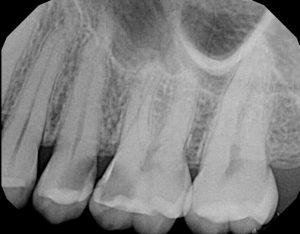
A tooth can be dying, or already dead, and still feel completely normal. Pain is a useful warning when it shows up, but no pain doesn’t mean nothing is wrong. The image below is from our own practice. That tooth had no symptoms at all. The dark areas at the tips of the roots are bone that had already been destroyed by inflammation the patient never felt.
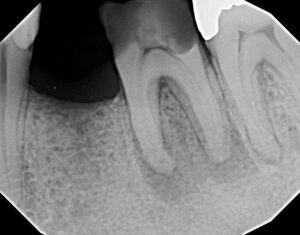
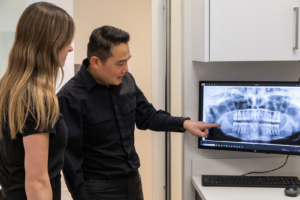
That’s why we diagnose with an examination, X-rays and testing instead of going by how the tooth feels, and why a routine examination is worth keeping up with. Most straightforward root canals are found this way, before anything hurts.
When It Can’t Wait
Once the infection has spread into the bone, it stops being just a dental problem. Facial swelling, a fever along with tooth pain, or trouble swallowing or opening your mouth needs same-day attention. Swelling that affects your eye, your breathing or your swallowing is a hospital emergency, so go to the hospital, not a dental office.
What Is Root Canal Treatment?
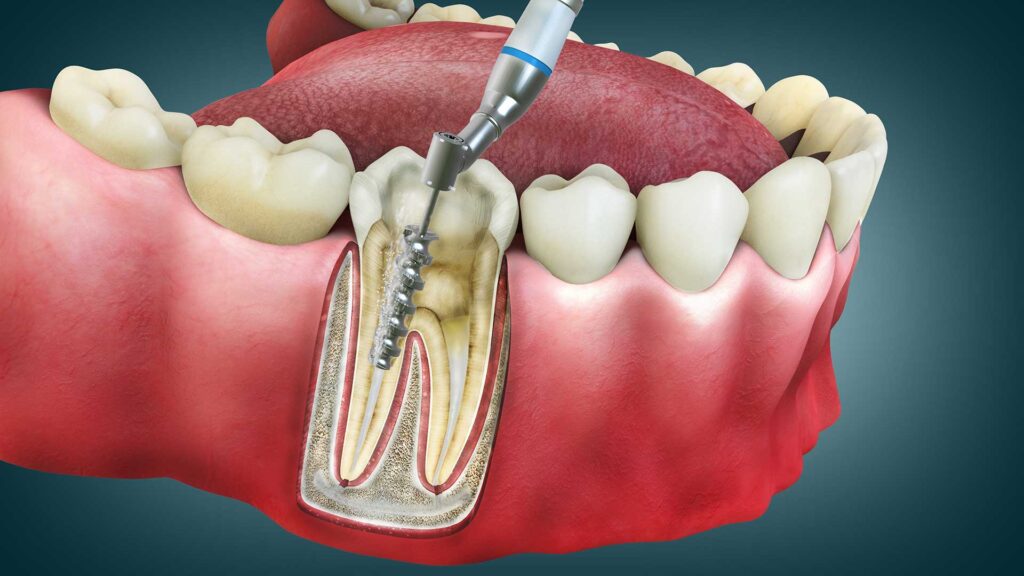
Root canal treatment removes infected or dying tissue from inside a tooth, disinfects the space it leaves behind, and seals it so bacteria can’t get back in. The tooth itself stays in your mouth. Only the tissue inside it comes out. Treatment inside the tooth is called endodontics, so endodontic treatment and root canal treatment mean the same thing.
Can Antibiotics Replace a Root Canal?
No. Antibiotics can’t fix infected tissue because antibiotics travel through the blood. A pulp that has died has no blood supply, so nothing you swallow can reach the inside of that tooth. Bacteria multiply in the dead tissue, and the only way to get rid of it is to physically remove it.
Root Canal or Extraction?
Once decay has reached the nerve, there are two reasonable treatments: save the tooth or take it out. Leaving it alone isn’t a third option. The infection won’t clear up on its own, and the longer it’s left, the more bone is lost around the root.
That said, a root canal isn’t always the right answer. A tooth with a crack running into the root, too little tooth left to rebuild, or serious bone loss around it may not be worth saving. If that’s the case with your tooth, we’ll tell you.
When it comes to cost, saving the tooth costs more upfront than taking it out, but less than taking it out and replacing it with a dental implant or a bridge. Waiting also costs more. A tooth that could have been saved can reach the point where it has to come out. Leaving a gap has its own cost, too. The teeth on either side drift toward the space, and the bone that held the root shrinks.
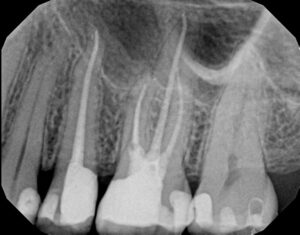
In this case that we saw in our practice, two upper teeth next to each other both had decay that had reached the nerve. The patient chose to save both, and both were crowned afterward.
A Note from Dr. Wong:
Root canals were falling out of favour in the early 2000’s, when implants were rapidly gaining in popularity. At the time, root canals were dismissed as just delaying the inevitable extraction of the tooth, so why not just jump to an implant and save the hassle? Fast forward a few decades on, and the pendulum has swung back towards root canals. The approach that we take is now: if a tooth has died, try your hardest to save it with a root canal (and crown if necessary), and even if it needs to be removed later, at least you’ve managed to delay the implant for that many more years. We know that implants are not free of complications, and they should be employed only when saving the tooth is no longer an option. We love both root canals and implants, but only when the circumstances are right for each. Among other things, we take into account the amount of remaining tooth structure, the gum and bone support, the overall bite, and of course the aesthetic implications. From a patient perspective, a root canal is actually pretty boring! Think of it like a very boring filling appointment.
What Happens During a Root Canal, Step by Step
A root canal happens in six stages, and it’s much closer to a long filling appointment than to surgery. Here’s what happens, in the order you’d go through it.
- Diagnosis. We examine the tooth, take X-rays and do some testing to confirm that the pulp is the problem and that the tooth is worth saving. This is also when we work out how many canals the tooth has. Molars usually have three or four, premolars usually have one or two, front teeth usually have one, and that number affects both how long the appointment takes and what it costs.
- Freezing. We use local anesthetic, so you shouldn’t feel the work. An infected tooth can be harder to freeze than a healthy one, so if you can feel anything, tell us rather than sitting through it.
- Isolation. We place a rubber dam over the tooth. Saliva carries bacteria, and the whole point of the appointment is to get the inside of the tooth clean, so we seal it off from the rest of your mouth.
- Access and decay removal. We make a small opening through the top of the tooth and remove the decay. This is often when we see how far the damage really goes.
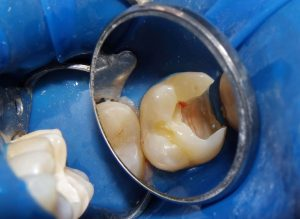
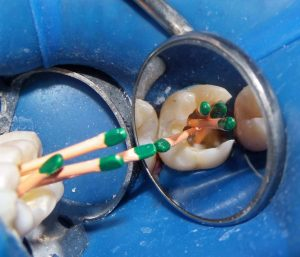
- Cleaning and disinfecting. Thin, flexible files widen each canal along its full length, and disinfecting rinses flush out what the files can’t reach. This is the most important part of the appointment, because the goal is to get the inside of the tooth clean and keep it that way.
6. Filling and sealing. We fill the cleaned canals with a rubber-like material and seal them so bacteria can’t work their way back in from the tip of the root. Then we fill the opening in the top of the tooth, either with a permanent filling at the same appointment or with a temporary one if the final restoration is being done at a separate visit. We’ll let you know which one you’re leaving with.
One more thing, from the patient’s side of the chair: there are a lot of instruments, but very little noise or movement, and most people find it more boring than they expected. Feel free to bring headphones. You can read more about our approach to root canal treatment on our service page.
How Long Does a Root Canal Take?
Most root canals are finished in one or two appointments, and a single appointment usually takes around 60 to 90 minutes. A front tooth with one canal takes less time than a molar with four.
Four things affect the timing: how many canals the tooth has, whether it’s a front or back tooth, how curved or narrow the roots are, and whether an infection needs to settle down first.
Do Root Canals Hurt?
We freeze the tooth first, so you shouldn’t feel the procedure itself. Most patients find the appointment less uncomfortable than the toothache that brought them in. Afterward, expect the tooth to be tender when you bite for a few days, and for that to ease steadily.
Root canals have a bad reputation, but a root canal is what gets rid of the pain. The pain people imagine when they hear the words actually comes from a tooth that has needed treatment for weeks, and by the time most patients are in the chair, they’ve already been through the worst of it. On top of that, actively painful teeth are notoriously difficult to freeze.
If dental appointments make you anxious, let us know when we first examine the tooth, not on the day of treatment. Sedation is available, and knowing ahead of time lets us plan the appointment around it.
Recovery and Aftercare
Most people go back to their normal routine the same day. Expect the tooth to feel tender when you bite for a few days, getting a little better each day. That’s what normal recovery looks like.
If the pain is getting worse after the first few days, if there’s any swelling, or if the tooth suddenly feels high when you bite, give us a call rather than waiting it out. A tooth that feels high usually just needs a small bite adjustment, which only takes a few minutes. For ordinary discomfort, follow the directions on whatever pain reliever you take, and ask your pharmacist or us if you’re not sure.
If the permanent restoration isn’t placed on the same day, you’ll leave with a temporary filling. It keeps the tooth sealed until the permanent one goes in, but it isn’t built to last. If it falls out or starts to crumble, call us to have it replaced rather than waiting for your next visit.
What Not to Eat After a Root Canal
Don’t eat anything until the freezing has completely worn off. That’s not to protect the tooth. It’s to protect your lip, cheek and tongue, which you can bite badly without feeling it.
If you left with a temporary filling, avoid hard, sticky and chewy foods on that side, because those are what pull a temporary filling out. Either way, chew on the other side until the permanent restoration is in. Until the biting surface is fully covered, a treated tooth is at its most fragile.
Why the Tooth Still Needs a Crown or Onlay
A root canal saves the tooth, but it doesn’t make it as strong as it was. However well the treatment goes, a treated tooth is weaker than an untreated one, and the restoration on top is what holds it together.
The reason is simple. Decay removes part of the tooth, and the opening we make to reach the canals removes a little more. What’s left can be closer to a shell than a solid tooth, and a shell can split under an ordinary bite. A cracked root usually can’t be saved, so the tooth would have to come out.
A crown or onlay covers the biting surface and holds the walls of the tooth together, which is what prevents that kind of fracture. Back teeth take the heaviest chewing forces and almost always need one. Front teeth often don’t. We’ll go over which one your tooth needs at the assessment, before treatment starts, so the plan and the estimate cover both the root canal and the restoration, and the second part doesn’t come as a surprise. Think of the crown or onlay as part of the treatment, not an optional extra. It protects everything you’ve already put into the tooth.
How Long Does a Root Canal Last?
A tooth that has been properly treated and properly restored can last for decades, and many last the rest of a person’s life. Nobody can promise you a lifetime, though, and the restoration on top usually has more to do with how long the tooth lasts than the root canal underneath.
When a treated tooth does have to come out, it’s far more often because of a leaking or broken restoration than a failed root canal. Four things shorten a treated tooth’s life: a permanent restoration that’s delayed or never placed, a back tooth left without full coverage, new decay around the edge of the restoration, and fracture.
A treated tooth can become infected again, but that isn’t the end of the road. Re-treatment is often possible, and when it isn’t, a small procedure at the tip of the root is sometimes the answer. Under the Canadian Dental Care Plan, re-treatment needs preauthorization, so allow time for that.
How Much Does a Root Canal Cost in Ontario?
There’s no single price for a root canal, but the fee isn’t random either. It depends on how many canals the tooth has, which tooth it is, and how complicated the roots turn out to be. Anyone who quotes you a price over the phone is guessing.
Ontario dentists work from the Ontario Dental Association (ODA) Suggested Fee Guide, which is updated every year. The guide isn’t mandatory, and every dentist sets their own fees.
Four things affect the price:
- The number of canals is the biggest factor, because a front tooth with one canal and a molar with four are billed under different codes.
- Which tooth it is comes next, and molars cost the most.
- Curved or narrow canals take longer, and we can only confirm those from an X-ray.
- And splitting treatment across two appointments adds to the total.
There’s one more thing that rarely gets mentioned, and it matters more than any of the above. If the tooth needs a crown or onlay afterward, and most back teeth do, that’s a separate fee under a separate code. So a quote for the root canal alone isn’t the cost of finishing the tooth. Ask any practice for both numbers together, and ask whether your tooth actually needs the second one. We give you a written estimate for whatever your tooth needs, after an examination and X-rays.
Does the Canadian Dental Care Plan Cover Root Canals?
Yes. Root canal treatment is one of the endodontic services covered by the Canadian Dental Care Plan (CDCP). To be eligible, your adjusted family net income has to be under $90,000, and you can’t have access to private dental coverage.
- Coverage depends on the tooth. Not every tooth qualifies, so ask us where your tooth falls.
- Re-treatment is handled differently. A first root canal on an eligible tooth generally doesn’t need approval from the plan in advance (called preauthorization). Re-treating a tooth that has already had a root canal does.
- The crown is assessed separately. A crown after a root canal is reviewed on its own, and it requires preauthorization.
There’s one more thing to ask about. The plan pays according to its own fee schedule rather than what your dentist charges, so you may be billed the difference on top of any co-payment. That means the question to ask isn’t just whether a practice accepts the plan, but whether it bills at the plan’s fees. Ask before treatment starts, and get the answer in writing.
Private insurance is separate, and a root canal plus a crown can use up most of a typical annual maximum on its own. Ask your insurer for a predetermination in writing.
Are Root Canals Bad for You?
No. The idea that root canals cause illness elsewhere in the body comes from something called focal infection theory. It was put forward more than a century ago and abandoned by researchers long before most of us were born, but it’s still going strong online, where evidence is optional.
The theory claimed that bacteria in teeth spread disease to other organs, and it was used to justify pulling huge numbers of healthy teeth. The research behind it couldn’t be reproduced.
It’s also worth remembering that the alternative to a root canal isn’t keeping a healthy tooth. It’s losing the tooth. If something you read online has worried you, bring it to your appointment and ask us about it.
When to See a Dentist in Barrie
Book an appointment if you have pain that wakes you up at night, pain that lingers after something cold, pain when you bite on the same tooth every time, a tooth that’s darkening, a tender spot on the gum, or a temporary filling that has come out.
If any of this sounds like what you’ve been feeling, the next step is an examination, not a root canal. We’ll look at the tooth, take X-rays, test whether the pulp is still alive, talk through whether the tooth is worth saving, and give you a written estimate before anything is decided. If the tooth can’t be saved, we’ll tell you so and go through what would work better.
Dr. Elston Wong Dentistry is at 222 Mapleview Dr. W, Units 1 and 2, in Barrie. Call 705‑721‑1143 or book an assessment through our contact page.
Frequently Asked Questions
How do I know if I need a root canal?
Watch for pain that lingers after something cold, pain when you bite on one tooth, a tooth that’s darkening, or a tender spot on the gum beside it. A tooth can also need a root canal without any symptoms at all, which is why we diagnose it with an examination and X-rays.
Do root canals hurt?
We freeze the tooth first, so you shouldn’t feel the procedure. Most patients find it less uncomfortable than the toothache that came before it. Expect the tooth to be tender when you bite for a few days. If appointments make you anxious, sedation is available.
How long does a root canal take?
Most are finished in one or two appointments, and a single appointment usually takes around 60 to 90 minutes. Molars take longer than front teeth because they have more canals. Treatment is sometimes split across two visits when an infection needs to settle down first.
Does the Canadian Dental Care Plan cover root canals?
Yes. Root canal treatment is part of the plan’s endodontic coverage for eligible patients. Eligibility depends on your household income and not having access to private coverage, and coverage depends on the tooth. Re-treatment requires preauthorization.
What should I not eat after a root canal?
Don’t eat anything until the freezing has worn off, because you can bite your lip or tongue without feeling it. While you have a temporary filling, avoid hard, sticky and chewy foods, and chew on the other side until the permanent restoration is in.
Can I avoid needing a root canal?
Sometimes. If decay is caught before it reaches the pulp, it can be treated with a filling instead, which is the best reason to keep up with regular examinations and X-rays. Once the pulp is irreversibly inflamed, a root canal or an extraction is the only option.
Is it better to have a root canal or pull the tooth?
If the tooth can be restored, it’s usually better to save it. Taking it out costs less upfront but more overall once you include replacing it, and a gap left alone lets the neighbouring teeth drift. Some teeth really can’t be saved, though. In those cases, the next step would be to explore replacement options.