


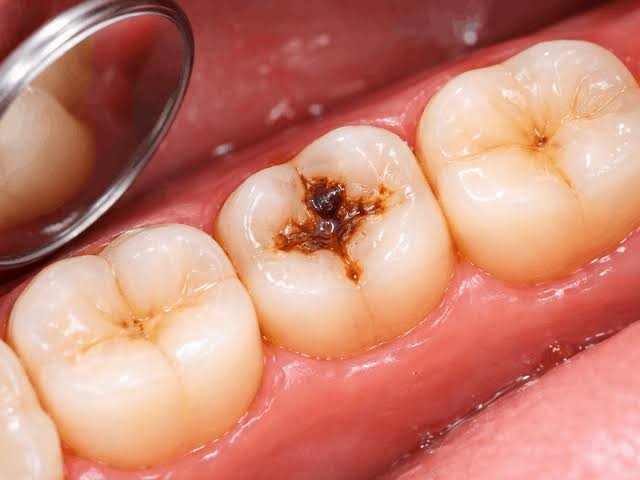
Cavities usually start small. You might notice a quick twinge when you drink something cold, discolouration on a tooth, or a dull ache when you bite down.
Wondering how to tell if you have a cavity? In this post, we’ll cover what a cavity is, the signs to watch for, how dentists diagnose and treat decay, what fillings are made of, what they cost in Ontario, and how to prevent the next cavity!
Getting a cavity doesn’t mean you’ve been careless. Some of the most diligent brushers we see still get decay, and there are good clinical reasons for that; read on to learn more.
What Is a Cavity, and How Does One Form?
A cavity is a hole in a tooth. Most commonly, it forms when bacteria in your mouth produce acid that dissolves minerals out of the tooth faster than your saliva can redeposit them. This mineral-leaching process itself is called dental caries. You can stop caries (and even reverse it!) in its early stages, but once it progresses to a cavity, the tooth can no longer repair itself.
It helps to know the three layers of a tooth:
- Enamel is the hard outer shell.
- Underneath it is dentin, which is softer and full of tiny channels that lead toward the nerve.
- In the centre is the pulp, the living core that holds the nerve and blood supply.
Your teeth take a little damage every time you eat, and they repair themselves in between. The bacteria in your mouth feed on what you eat and turn it into acid, and that acid softens the tooth. Once the pH at the tooth surface drops below about 5.5, minerals start to leave the enamel. That’s called demineralization. Your saliva then neutralizes the acid and brings calcium, phosphate and fluoride minerals back into the tooth. That’s remineralization.
Trouble starts when acid shows up so often that your saliva never gets the chance to finish the repair. That’s why how often you have sugar matters more than how much. A sweetened coffee sipped over two hours keeps the pH dangerously low for most of that time. A chocolate bar eaten in five minutes is one acid attack, followed by hours of recovery. The chocolate bar has far more sugar, but the coffee does more damage. (Sorry, coffee lovers.)
The Stages of Tooth Decay
Decay doesn’t go from a healthy tooth to a hole overnight. It moves through several stages, and the stage it reaches determines treatment far more than how it feels.
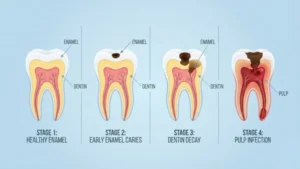
- White spot lesion. A chalky patch where minerals have been lost from below an intact surface. This is the only stage that can be reversed with fluoride/hydroxyapatite and fewer acid attacks.
- Enamel lesion. The enamel starts breaking down from the inside, and the patch often darkens. It still doesn’t hurt, because enamel has no nerves.
- Dentin lesion. The decay reaches the dentin and speeds up because dentin is softer. This is usually when symptoms start and when a filling becomes necessary. Sometimes people feel nothing at all, despite the decay reaching this depth.
- Pulp involvement. The nerve becomes inflamed. If the inflammation is reversible, it settles once the decay is removed. If it’s irreversible, it won’t settle, and the tooth needs a root canal or has to come out.
- Abscess. The pulp dies, and bacteria travel out through the tip of the root into the bone, causing swelling and throbbing pain. At this stage, you need to see a dentist as soon as possible.
What Does a Cavity Look Like? Signs to Watch For
A cavity can look like a chalky white patch, a brown or black spot, or a small pit in the chewing surface of a tooth. Plenty of cavities can’t be seen at all, and the first sign is more often something you feel.
- Sensitivity to cold or heat. A short, sharp twinge that goes away once the cold or heat is gone.
- Sensitivity to sweets. When sugar reaches the dentin through broken enamel, the tooth can ache for several seconds.
- Pain when you bite. Discomfort in one tooth when you bite down, in the same spot every time.
- A toothache that won’t go away. Pain that comes on for no reason, or pain that wakes you up at night, usually means the decay is close to the pulp.
- A hole or pit you can see. This is usually on a molar. You might feel it with your tongue, or notice floss catching on it.
- Food getting stuck in a new spot. This often means decay has broken down the contact point between two teeth.
- White, brown or black staining. Chalky white suggests early mineral loss. Brown or black usually means the decay has been active for a while.
Why Some Decay Can’t Be Seen in the Mirror
There are two places you can’t check for yourself:
The first is between your teeth, where the surfaces are hidden by the point where the two teeth touch.
The second is under an existing filling.
Decay can work its way in around the edge of a filling and hollow out the dentin underneath, while the top of the tooth still looks normal. In a routine finding at our office, a filling that looks perfectly good is frequently found to hide decay well into the dentin.
Why You Can Get Cavities Even When You Brush and Floss
Brushing can’t reach every surface where decay starts. If you brush twice a day, floss most nights, and still get told you have a cavity. Here’s why:
- Pits and grooves. The grooves on your molars are narrower than a single toothbrush bristle. This is exactly the problem sealants solve.
- Between the teeth. Where two teeth touch, a toothbrush can’t get in, and plaque holds acid against both surfaces at once.
- Snacking and sipping. This is the big one. Juice, coffee with sugar or even just cream or milk, and sports drinks all count, and diet drinks are acidic on their own, even without sugar. What matters is how many separate times a day your teeth are exposed.
- Dry mouth. Saliva is what neutralizes acid and repairs your teeth. Many common medications reduce it, and when that happens, the risk of decay goes up sharply.
- Reflux or repeated vomiting. Strictly speaking, this isn’t traditional decay. Stomach acid wears away the enamel directly, without any bacteria or plaque involved. This is called acid erosion.
- Receding gums. These expose the root surface, which is softer than enamel and decays faster.
When It’s Not a Cavity
- A cracked tooth. Sharp pain when you let go of a bite, rather than when you bite down.
- Receding gums or worn enamel near the gumline. Cold sensitivity across a wider area (multiple teeth), rather than in one spot.
- Clenching or grinding. A general ache across several teeth, usually worse in the morning.
- Sinus pressure. Several upper back teeth aching at the same time, worse when you bend forward.
- Gum disease. Bleeding and tenderness along the gumline, rather than in the tooth itself.
Types of Cavities and Where They Form
Where a cavity sits affects how it’s found and how quickly it grows.
- Pit and fissure cavities form in the grooves of teeth, typically the biting surface of back teeth. They’re the most common type in children and teenagers.
- Smooth surface cavities form along the gumline. They’re the slowest to grow and the most likely to stop progressing.
- Interproximal cavities form between two teeth. You can’t see them in a mirror, and they’re usually found only on a bitewing X-ray.
- Root cavities form on root surfaces exposed by receding gums. Roots start losing minerals at a higher pH than enamel does, so decay starts sooner and moves faster. This is the type that matters most for older patients. In rarer cases, this may also be due to the species of bacteria present, which may be capable of destroying tooth material without acid present.t
- Recurrent decay forms around the edge of an existing filling. It’s the most common reason a filling has to be replaced. Once the edges of a filling begin to break down from wear and tear and the seal is compromised, it can often allow entry of bacteria underneath.
How Cavities Are Diagnosed
We dry the teeth and examine them under good light and magnification. The tricky part is telling an active cavity apart from an old stain, and that takes judgment. A stain is hard, shiny and looks the same from one visit to the next. An active cavity is dull, chalky, slightly soft, and getting bigger.
Two types of X-ray do most of the work.
A bitewing shows the crowns of your upper and lower back teeth together, and it’s the only reliable way to see between them.
A periapical X-ray shows the whole tooth, including the bone around the tip of the root, and we typically use it when a tooth is causing symptoms.
How often we take X-rays depends on your risk of decay, not on the calendar.
As for the question patients often have but rarely ask: according to the International Atomic Energy Agency, the dose of radiation from a bitewing or periapical X-ray is usually less than the natural background radiation you absorb in an ordinary day. Digital sensors and collimation, which narrows the X-ray beam, reduce it even further.
If we recommend a filling, ask to see why. We can show you a photo, the X-ray, or both. A cavity that really needs filling is easy to see once it’s pointed out, and it’s perfectly reasonable to ask whether watching it for six months is an option instead.
What Happens If You Don’t Treat a Cavity?
Left alone, decay usually keeps going, and each step makes treatment more involved and more expensive.
First, the tooth becomes sensitive as the decay reaches the dentin. Then the pulp becomes inflamed. If that inflammation is reversible, it settles once the decay is removed. If it isn’t, the tooth needs a root canal or has to come out. If nothing is done, the pulp eventually dies. That part doesn’t hurt, so people sometimes assume the problem has gone away. It hasn’t. Bacteria then spread through the tip of the root into the bone and cause an abscess. Facial swelling with a fever is a same-day emergency.
Most people never see the costs laid out in order. A filling on one surface of a tooth is the least expensive restorative treatment in dentistry. A filling that covers several surfaces costs more. An onlay or crown costs several times as much as a filling, and a root canal plus the crown that follows costs several times more again. That’s worth keeping in mind if you’re deciding whether to book.
How fast this happens varies. Decay can take years to get through the enamel. Once it reaches the dentin, it moves much faster, and on root surfaces faster still. If a cavity is early and slow-moving, keeping an eye on it is a perfectly good plan, and our dentists will tell you so.
How Cavities Are Treated
Treatment works like a ladder: we start at the bottom and only go as high as the tooth needs. An early cavity with the surface still intact doesn’t automatically need drilling. Fluoride, fewer acid attacks and a follow-up visit are often enough. In a recent case here, we left a few small lesions to remineralize while we dealt with what was causing them. Not every dark spot needs a filling.
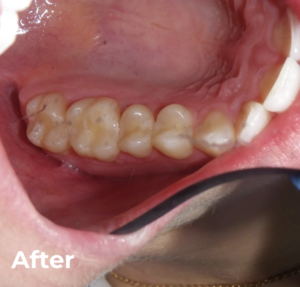
A Note from Dr. Wong:
Believe it or not, dentists don’t like drilling teeth. We understand that nothing lasts as long as real tooth structure, so we always try to do everything we can to remineralize teeth and delay that first filling. This is why prevention with good hygiene and diet practices is so important. If decay gets to the point of actually needing a filling, we make choices that will allow us to preserve tooth structure and/or minimize the number of future interventions. This includes the use of technology and materials that will allow us to make smaller holes and create stronger bonds to teeth. We don’t buy the cheap stuff!
Between watching a cavity and drilling it, there are a few minimally invasive options:
- Silver diamine fluoride stops active decay without freezing or drilling, although it permanently stains the decayed area black (useful for people who cannot sit very long for dental appointments).
- Resin infiltration seals early cavities between the teeth, as well as the white spots that braces sometimes leave behind.
- With selective caries removal, we leave a thin layer of affected dentin over the pulp instead of risking exposing the nerve, and then seal it in.
A cavity that has broken through the surface needs a filling. If too much of the tooth is gone, an onlay or crown covers and protects what’s left. If the decay has reached the pulp, the options are a root canal or taking the tooth out.
Filling Materials Compared
Most of the fillings we place are composite resin. That’s a deliberate choice, but it isn’t the only option.
- Composite is a tooth-coloured resin that’s placed in layers and hardened with a curing light. These are what most people call white fillings. Because composite bonds to the tooth, we don’t have to remove as much healthy tooth to hold it in place. It needs a completely clean tooth to bond properly, which is why we use a rubber dam or other isolation.
- Amalgam, the silver filling, is a mix of silver, tin, copper and mercury. Instead of being bonded to the tooth, it’s packed in. It’s durable and inexpensive, but more healthy tooth has to be cut away to hold it in place; it doesn’t seal the edges the way a bonded filling does, and it’s being phased out. Still, it’s a useful option in specific situations.
- Glass ionomer bonds to the tooth chemically and releases fluoride. It wears faster, so it’s better suited to cavities on root surfaces, fillings along the gumline and linings under other fillings than to the surfaces you chew on.
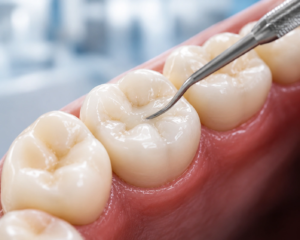
- Ceramic inlays and onlays are custom-made to fit the tooth and then bonded in. They can protect weakened cusps, the raised points on a back tooth, rather than just filling a hole. Gold is the other option here, and in long-term studies, gold outlasts all of the other materials. Both ceramic and gold cost several times as much as a filling.
Are Silver Fillings Safe, and Should You Replace Yours?
Health Canada’s position statement on dental amalgam, which was affirmed by an updated risk assessment in 2020, concluded that amalgam is the largest single source of mercury exposure for the average Canadian, but that it isn’t causing illness in the general population and a total ban isn’t justified. It also found no evidence linking amalgam to Alzheimer’s disease, multiple sclerosis or Parkinson’s disease.
Health Canada does recommend avoiding amalgam in children’s baby teeth and in patients with impaired kidney function. It also recommends that, wherever possible, amalgam fillings not be placed in or removed from the teeth of pregnant patients. Separately, amalgam is being phased out worldwide by 2034 under the Minamata Convention on Mercury. That decision was made for environmental reasons, not because amalgam was found to harm patients.
There’s no health reason to remove silver fillings that are in good shape, and taking them out is actually when the most mercury is released. Replace them if there’s decay around the edge, a crack, or wear. Wanting them replaced because of how they look is a perfectly valid reason too.
What Happens at the Appointment
- First, we freeze the tooth, so the procedure itself doesn’t hurt.
- We then isolate the tooth with a rubber dam (or alternative) to keep it dry.
- Next, we remove the decay and any old filling that’s failing, and that step is what decides how long the appointment takes.
- If the cavity involves the wall between two teeth, we use a band and ring to rebuild that wall, so the filling has the right shape and touches the tooth beside it properly.
- Finally, we bond the surface, place the composite in layers, harden each layer with the light, and adjust your bite.
A straightforward filling takes about 30 to 60 minutes. You can eat once the freezing wears off. It’s normal for the tooth to be a little sensitive for a few days, and that should ease steadily. If the sensitivity gets worse, or the filling feels high when you bite, call us. It’s a quick adjustment, and there’s no point waiting it out.
What Does a Filling Cost in Ontario?
There’s no single price, but the fees do follow a set structure. Ontario dentists work from the Ontario Dental Association guide, which is updated every year. The word “suggested” is important here. The guide itself says it isn’t mandatory, and each dentist sets their own fees.
How Much Is a Filling in Ontario?
The fee comes down to four things.
- The number of surfaces. This is the biggest factor. Every tooth has five surfaces, and the fee goes up with each one the filling covers. A small cavity on one surface is a much smaller job than one that wraps around three.
- The type of tooth. Front teeth, premolars and molars are priced separately, and molars cost the most.
- Baby tooth or adult tooth. A child’s baby tooth is coded differently.
- The material. This is coded separately. Inlays, onlays and crowns fall into a different category altogether.
What Is Covered?
Most private insurance plans cover fillings at a percentage of a fee guide, up to an annual maximum. Many of them pay based on an older year of the guide than the one your dentist uses, so 80 percent coverage can end up being 80 percent of a smaller number.
The Canadian Dental Care Plan is open to eligible residents of all ages, and fillings are covered. To qualify, your adjusted family net income has to be under $90,000, and you can’t have access to private dental coverage. Your co-payment depends on your income: nothing if it’s under $70,000, 40 percent of the plan’s fee between $70,000 and $79,999, and 60 percent between $80,000 and $89,999. (Please read the next two paragraphs carefully).
The word that trips people up is access. If dental coverage is available to you through work or a pension, you’re not eligible, even if you’ve never used it or decided not to sign up.
BUT, be aware that the CDCP plan also pays according to its own fee schedule rather than what your dentist charges, so you may be billed the difference on top of any co-payment. That means the question to ask isn’t just whether a practice accepts the plan, but whether it bills at the plan’s fees. Ask before treatment starts, and ask for the answer in writing.
How to Prevent the Next Cavity
The biggest change most people can make is cutting down on how often sugar and acid reach their teeth, rather than how much.
Brush twice a day with a fluoride toothpaste, and clean between your teeth every day. Then cut down the number of separate times each day your teeth are exposed to sugar or acid. Finish a drink instead of sipping it all morning, keep sweets to mealtimes, and drink water in between. After something acidic, rinse and wait about 30 minutes before brushing, because brushing softened enamel wears minerals away.
In the office, dental sealants close off the deep grooves in molars, and they’re just as useful for adults with unsealed grooves as they are for children. A professional fluoride treatment delivers a higher concentration of fluoride to teeth that show early signs of mineral loss. And if you keep getting cavities despite good habits, biofilm DNA testing can identify which bacteria are present.
For patients at higher risk, we offer different rinses and toothpastes to arrest or prevent decay. It’s worth considering if you have a dry mouth, exposed root surfaces, three or more fillings in the last three years, or a diet that’s consistently high in sugar. If your decay is being driven by reflux or a high-acid diet, though, removing the source of the acid is what helps.
That’s really the main point of everything above. Filling the hole is only part of the job. The more valuable part is working out why it appeared in the first place.
When to See a Dentist in Barrie
Book an appointment if you have pain that wakes you up at night, a hole or dark spot you can see, sensitivity that lasts more than a few days, a filling that feels rough or has broken, or food that gets stuck in the same spot every time you eat.
Some things shouldn’t wait. Facial swelling, a fever along with tooth pain, a broken tooth, or pain that over-the-counter painkillers can’t control should be seen the same day. If swelling is closing an eye or making it hard to swallow, go to the hospital. That’s a medical emergency, not a dental one.
If anything here sounds like what you’ve been feeling, the next step is an examination, not a filling. Dr. Wong will look at what’s actually going on, take X-rays if needed, and go over your risk of getting cavities, so that treatment deals with the cause and not just the symptom.
Dr. Elston Wong Dentistry is at 222 Mapleview Dr. W, Units 1 and 2, in Barrie. Call 705‑721‑1143 or book through our contact page. Thanks for reading!
Frequently Asked Questions
Can a cavity go away on its own?
Early decay can. If minerals have been lost but the enamel surface is still intact, fluoride and fewer acid attacks can remineralize it. Once the surface has broken down and a cavity has formed, part of the tooth is physically missing and has to be restored.
Is a black spot on a tooth always a cavity?
No. It could be active decay, decay that has stopped, ordinary staining in a deep groove, or the dark edge of an old filling. Active decay is dull, slightly soft and getting bigger. A stain is hard, shiny and doesn’t change.
Do cavity fillings hurt?
We freeze the tooth first, so you shouldn’t feel the procedure. The freezing itself is a quick pinch, followed by a couple of hours of numbness. If dental visits make you anxious, let us know. We offer sedation and use it regularly.
How long does a filling last?
No filling lasts forever. How long one lasts depends on the material, the size of the filling, your bite, whether you clench, how well you clean, and your diet. Small fillings tend to outlast large ones. With modern bonding techniques and materials, it would not be surprising to see a filling last over ten to fifteen years.
Do cavities in baby teeth need to be filled?
Usually, yes. Baby molars don’t fall out until around age 10 to 12, so a cavity at age five has years to get worse. Untreated decay causes pain and infection, can affect the adult tooth developing underneath, and if the baby tooth is lost early, the neighbouring teeth can drift into the gap.
Does the Canadian Dental Care Plan cover fillings?
Yes, fillings are covered. To be eligible, your adjusted family net income has to be under $90,000, and you can’t have access to private dental coverage. Your co-payment depends on your income. Before treatment, ask whether the practice bills at the plan’s fees.