


Maybe a front tooth has started to overlap its neighbour. Maybe the crowding you had at 20 is worse at 40. Or perhaps you have wanted to fix your smile for years and kept putting it off.
Clear aligners are how we straighten teeth at Dr. Elston Wong Dentistry. No brackets. No wires. Just a series of clear, removable trays.
This guide covers how clear aligners work, what they fix well and where they fall short, how long treatment takes, what changes the cost, and what insurance and the Canadian Dental Care Plan (CDCP) will pay for.
What Are Clear Aligners?
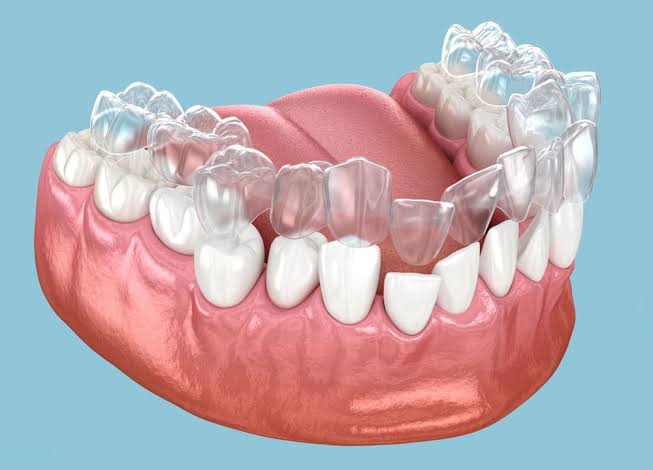
Clear aligners are thin, custom-made plastic trays that fit snugly over your teeth. When you start treatment, you receive a series of trays, typically worn for about one week per tray. Each tray is shaped slightly differently from the one before. Worn in order, they move your teeth a small step at a time toward a final position that is planned before you start.
- You wear each tray for one to two weeks, then switch to the next one.
- They come out to eat, to drink anything other than water, and to brush.
- They are close to invisible. Most people will not notice unless you tell them.
- The whole series is planned from a scan or impressions of your teeth before the first tray is made.
Invisalign and Other Clear Aligners: Is There a Difference?
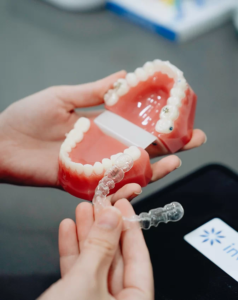
Invisalign is presently the best-known brand of clear aligner, but it is one of several in the marketplace. They all work the same way: custom trays, worn in sequence, planned from a scan of your teeth, that gradually move teeth towards a final position.
We offer Invisalign and similar clear aligners for patients who want a discreet way to straighten their teeth.
The brand matters less than two things: how carefully the movement is planned, and who is checking your teeth while you wear the trays. You can read more about clear aligner treatment on our service page, alongside the rest of our smile makeover options.
How Do Clear Aligners Move Teeth?
Each tray presses gently and steadily on specific teeth. The bone around a tooth gives way slightly on the side being pushed and rebuilds behind it. That takes time, which is why teeth move slowly, and why pushing harder does not make them move faster.
Most cases use one or two small helpers:
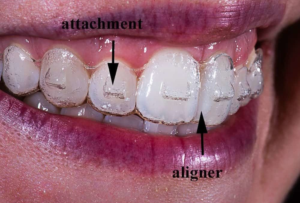
- Attachments. Small, tooth-coloured bumps bonded to some teeth. They give the tray something to grip, so it can turn or lift a tooth. They are polished off at the end.
- Interproximal reduction (IPR). A tiny amount of enamel is polished from between crowded teeth to make room. It is a fraction of a millimetre, not a meaningful part of the tooth.
And one thing that surprises people:
- Refinements. Teeth do not always follow the plan exactly. A short extra set of trays fine-tunes the result. This is a normal part of treatment, not a sign that something went wrong.
What Can Clear Aligners Fix?
Clear aligners work well for crowding, gaps, rotated teeth and teeth that have drifted. They can also correct many mild to moderate bite problems. They are less predictable for large rotations, big vertical movements, and bite problems caused by the position of the jaw rather than the teeth.
Usually a good fit:
- Crowded or overlapping teeth
- Gaps between teeth
- Teeth that have shifted over the years, including after earlier orthodontic treatment
- A tooth that has turned
- Mild to moderate overbites, crossbites and underbites, depending on what is causing them
Less predictable:
- Large rotations, especially of rounder teeth
- Moving teeth a long way up or down
- Bite problems that come from the jaw itself, not the teeth
Bite terms get mixed up all the time:
- Overbite: how far your upper front teeth cover your lower ones (this is a vertical measure).
- Overjet: how far your upper front teeth stick out over your lower ones (this is a horizontal measure).
- Crossbite: some upper teeth close inside the lower ones instead of outside.
Crooked teeth are not a disease, but they are not only a looks problem either. Poor alignment can contribute to headaches and jaw pain, which is why we look at your bite and jaw joints as well as your smile. Straighter teeth are also easier to keep clean, because crowding leaves fewer places for plaque to hide.
Straightening is different from covering up. Aligners change where a tooth sits, while veneers change how it looks from the front.
If your case would be better handled by an orthodontist, we will tell you and explain why.
Who Are Clear Aligners Right For?
Most adults and teens can be treated with clear aligners if their oral hygiene, gum health and general health allow it. Age is not the limit. Existing dental work and the commitment to wear the trays 20 to 22 hours a day also determine whether aligners will work.
Clear Aligners for Adults
- Teeth move the same way at 50 as they do at 15 (albeit a bit more slowly), and more adults are straightening their teeth than ever.
- Common adult reasons: crowding that has slowly worsened, teeth drifting into a gap, or straightening before crowns or veneers so less natural tooth has to be removed.
- Gum disease has to be under control first. Moving teeth through inflamed gums makes the problem worse.
If You Have Crowns, Bridges or Implants
- A tooth with a crown moves normally, because the root underneath has not been touched.
- A dental implant is fixed in the bone and does not move at all.
- A bridge joins teeth together, so they will typically not move at all.a.
- We check all of this before anything is planned.
Clear Aligners for Teens
- Aligners can work well for teens once most of the adult teeth have come in.
- The catch is wear time. A tray left in a pocket or a backpack is not moving anything.
- Teens who do well with aligners are usually the ones who want them, not the ones being talked into them.
A Note from Dr. Wong:
So often we hear the phrase “I’m too old for braces”, but let’s give you some perspective. If an adult has significant tooth crowding or rotations in addition to broken teeth, the absolute best way to address these problems is to do it right: get the big parts in the right place, and the details are much easier to make look amazing. If we don’t do it this way, then we’re compromising – either you’re going to get a result that is less than ideal, or we’re going to have to cut down a lot more tooth.
When we propose orthodontic treatment, it’s going to last about one to two years: not a lot of time, considering the decades of benefit that you will derive from it. The veneer-only craze of the late 90’s is a thing of the past because it involved lots of drilling of healthy tooth structure. Now it’s all about responsible aesthetics, which often means properly positioning teeth (orthodontics) before doing any cosmetic bonding or veneers. So for any oral reconstruction project, orthodontics is essential for optimal management!
What Happens Before You Start?
Treatment starts with an assessment, not a commitment. We examine your teeth and gums, take X-rays and records, and listen to what bothers you. You leave with a plan, an estimated timeline and a written fee before any trays are ordered.
- Your concern, in your words. What bothers you sets the goal, from how your smile looks to how your jaw feels, and we talk honestly about whether that result is realistic.
- An examination. Teeth, gums, bite, jaw joints and any existing dental work.
- X-rays. To check the roots and the bone around them.
- Records. Photos and a digital scan or impressions of your teeth.
- The plan. How your teeth are planned to move, roughly how long it will take, and the fee.
- Fitting day. Attachments are bonded, the first trays are fitted, and we show you how to wear and clean them.
If anything needs treating first, such as a cavity or gum inflammation, we deal with that before the trays go in. Moving teeth around active decay or gum disease only makes both worse.
How Long Does Clear Aligner Treatment Take?
Simple cases can take well under a year. Fuller cases usually take 18 to 24 months, sometimes longer. Your plan gives you an estimate before you start. The biggest factor you control is how many hours a day the trays are actually in your mouth.
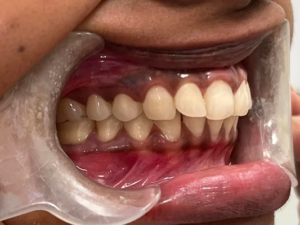
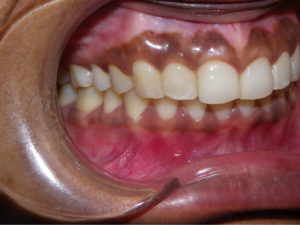
In one of our own Invisalign cases, a patient unhappy with crowding in her upper front teeth finished in seven months with a simple sequence of aligners. She then wore clear retainers at night to hold the result.
What makes treatment longer:
- Bigger movements, or changes to how the upper and lower teeth meet
- Refinements, if teeth need a little more fine-tuning at the end
- Wearing the trays less than 20 to 22 hours a day
- Missed check-ins, which are how we confirm your teeth are moving as planned
Teeth sit in bone, and bone remodels at its own pace. That is why there is no safe way to rush it.
What Is It Like to Wear Clear Aligners?
Each new tray feels tight for a day or two, then settles. Most people adapt within a week or two. The bigger change is your routine: trays out to eat, teeth brushed before they go back in, and 20 to 22 hours of wear every day.
Do Clear Aligners Hurt?
- They cause pressure, not sharp pain. Expect tenderness for a day or two after each tray change.
- Soft food helps. Over-the-counter pain relief is fine if you need it, following the package directions.
- If a tray edge rubs your cheek or tongue, tell us. It can be smoothed.
- Some people lisp slightly for the first few days. It usually fades as your tongue gets used to the trays.
Eating and Drinking With Aligners
- Take your trays out to eat. There is no food list to memorize.
- Only drink water with the trays in. Anything sugary or acidic gets trapped against your teeth for hours, which is how cavities form.
- Hot drinks can warp the plastic. Coffee and tea stain them.
- Brush, or at least rinse, before the trays go back in.
- No gum with trays in.
Keeping Your Aligners Clean
- Rinse them in cool or lukewarm water. Hot water warps them.
- Brush them gently with a soft brush. Toothpaste scratches the plastic and makes it cloudy.
- Cleaning crystals or tablets made for aligners work well. Follow the package directions.
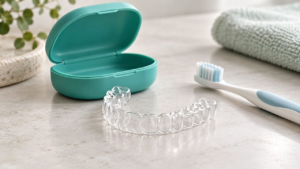
- Keep them in their case. Most lost trays end up wrapped in a napkin and thrown out.
- Keep up with your hygiene appointments. They matter more during treatment, not less.
How Much Do Clear Aligners Cost?
Clear aligner treatment is quoted as one fee for the whole case, and the cost is spread out over the course of treatment rather than paid at once. The fee depends on how complex your case is and how long it will take. You get that fee in writing after your assessment.
What Changes the Price
- How complex the movement is. Lining up two crowded front teeth is a much smaller job than correcting an overall bite.
- One arch or both. Treating one arch is not half the price of treating both arches, because most of the planning is the same. Seldom is there one-arch treatment because upper teeth need to be able to match the bite on the lower teeth.
- How long treatment will take, and how many trays and refinements that involves.
- Anything needed first, such as a cleaning, a filling or gum treatment.
How Much Is Invisalign or Clear Aligner Treatment in Ontario?
Ontario dentists use the Ontario Dental Association (ODA) Suggested Fee Guide, updated every year. It is a guide, not a price list, and each practice sets its own fees. On top of that, depending on the case, there is actually no “standard” fee for orthodontics.
That is why prices you see online vary so much, and why nobody can give you an accurate figure over the phone. The fee depends on how far your teeth have to move, and nobody knows that until they have been examined.
When you compare quotes, check whether each one includes:
- The assessment, X-rays and records
- Every tray, including refinements
- Attachments, and removing them at the end
- Check-in appointments during treatment
- Your retainers
A lower quote that leaves out refinements or retainers is not actually lower.
Is Invisalign Covered by Insurance in Canada?
This is entirely dependent on your insurance. Some policies have coverage, some have age limits, or lifetime cost limits. Orthodontic coverage works differently from the rest of your plan:
- It usually has its own lifetime maximum, separate from your yearly maximum.
- It is often paid at a lower percentage.
- Many plans have a waiting period and an age limit for dependants.
- Some plans treat aligners the same as any other orthodontic treatment. Some do not.
Ask your insurer for a predetermination in writing before you start. Your plan then tells you what it will pay before you commit.
Does the Canadian Dental Care Plan Cover Clear Aligners?
No, not at this time. The plan’s current benefits guide says limited orthodontic services will be available at a date still to be determined. Even then, “limited” is the key word, so do not count on the plan for straightening.
What the plan does cover still helps. Examinations, X-rays, cleanings and fillings are covered, so the work that has to happen before aligners may be covered even though the aligners are not. You can check the current Canadian Dental Care Plan benefits guide yourself.
Can You Claim Clear Aligners on Your Taxes?
Often, yes. Orthodontic treatment is generally an eligible medical expense for the federal medical expense tax credit. You can only claim what you paid yourself, not what insurance covered. Purely cosmetic procedures are treated differently, so check the Canada Revenue Agency’s list of eligible medical expenses.
Are At-Home, Mail-Order Aligners Worth It?
A little while ago, there was a disastrous failure of a company called Smile Direct Club, which promoted the use of self-directed aligners at a significant discount, without dentist involvement. This predictably led to a LOT of failed treatment, and ultimately a 2023 bankruptcy while leaving plenty of patients hanging with incomplete treatment and no recourse but to seek actual dentists / orthodontists to correct the treatment that had been started. The lesson here? The plastic is not the problem. The missing examination is. Mail-order aligners have no idea what movements are feasible in an individual, given that they skip the X-rays, the gum check, and the in-person follow-up, so decay, gum disease or a slowly worsening bite can go unnoticed while your teeth are being moved.
- No X-rays. Nobody checks the roots or the bone your teeth are being moved through.
- No gum check. Moving teeth through active gum disease makes it worse.
- No way to adjust. If teeth do not move as the computer predicted, a pre-made set of trays cannot change course.
- The price is not the full price. Fixing a result that has gone wrong costs far more than doing it properly the first time.
The Canadian Dental Association has made the same point: aligners are active appliances, and they need a dentist’s direct and ongoing supervision.
None of this is an argument against aligners. It is an argument for having someone watch your teeth while they move.
What Happens After Clear Aligner Treatment?
You wear a retainer. Teeth keep trying to drift back for life, so a retainer is the last stage of treatment, not an optional extra. Most people wear it full time at first, then switch to nights only for the long term. Just as no part of your body stays unchanged over time, neither should you expect your teeth to remain fixed in time.
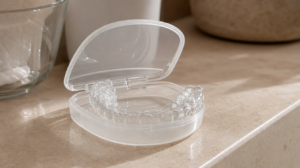
- Clear removable retainer. A thin tray, much like an aligner, that holds your teeth where they finished. It only works when you wear it.
- Bonded retainer. A thin wire fixed behind the front teeth, often called a permanent retainer. All it asks is that you keep it clean.
- Many people end up with one of each.
Look after them the same way as your aligners: cool water, a soft brush, no toothpaste, and always the case. For a bonded wire, use a floss threader or water flosser to clean underneath.
If your retainer suddenly does not fit, or a bonded wire comes loose, call us that week. A small amount of movement can usually be corrected. Several months of it means going through treatment again.
Talk to Dr. Elston Wong in Barrie
The first step is an assessment, not a commitment. We examine your teeth, take the X-rays and records we need, talk through whether aligners suit you, and give you a written fee before anything is agreed. You are welcome to take it home and think it over.
We are a general dental practice that provides clear aligner treatment, not an orthodontic specialty practice. If your case is better handled by an orthodontist, we will say so and explain why. You can see a finished Invisalign case on our site, or try our virtual smile simulation before you come in.
Dr. Elston Wong Dentistry is at 222 Mapleview Dr. W, Units 1 and 2, in Barrie. Call 705-721-1143 or book an assessment through our contact page. Thanks for reading!
Frequently Asked Questions
How much do clear aligners cost?
Clear aligner treatment is quoted as one fee for the whole case, spread out over the course of treatment. The price depends on how complex your case is and how long it will take. We give you a written fee after an examination and records, before anything is ordered.
Is Invisalign different from other clear aligners?
Invisalign is one brand of this type of treatment, and there are several others. All use custom clear trays, worn in sequence and with tooth movement planned digitally from a scan of your teeth. The results depend less on the brand and more on how carefully the movement is planned and how closely your progress is checked.
How many hours a day do you wear clear aligners?
Twenty to 22 hours a day. Take them out only to eat, to drink anything other than water, and to brush. Teeth only move while the trays are in, so short wear time is the most common reason treatment runs longer than planned.
How long does clear aligner treatment take?
Simple cases can take well under a year. Fuller cases usually take 18 to 24 months. Your treatment plan gives you an estimate before you start. Bigger movements, refinements and short daily wear time all make treatment longer.
Does insurance cover clear aligners in Canada?
Often partly, if your plan has orthodontic coverage. That coverage usually has its own lifetime maximum and may include waiting periods or age limits for dependants. The Canadian Dental Care Plan does not currently cover orthodontic treatment. Ask your insurer for a written predetermination before you start.
Can clear aligners fix an overbite?
Often, yes, when the overbite is mild to moderate and comes from the position of the teeth. When it comes from the position of the jaw, aligners are less predictable. An examination and X-rays show which one you have and whether aligners are the right tool.
Do I need a retainer after clear aligners?
Yes. Teeth keep trying to move back for life, so a retainer is part of treatment, not an extra. Most people wear a clear retainer full time at first, then at night long term. Many also have a thin wire bonded behind the front teeth.
Am I too old for clear aligners?
No. Teeth move the same way at 50 as they do at 15. What matters is healthy gums, enough bone around the teeth, and checking any crowns, bridges or implants first. An implant does not move at all, so it changes what is possible. The number of adults undergoing orthodontic treatment is dramatically rising due to the inconspicuous nature of clear aligners, opening up the door to more comprehensive, proper treatment.