



Crowns & Onlays at Dr. Elston Wong Dentistry
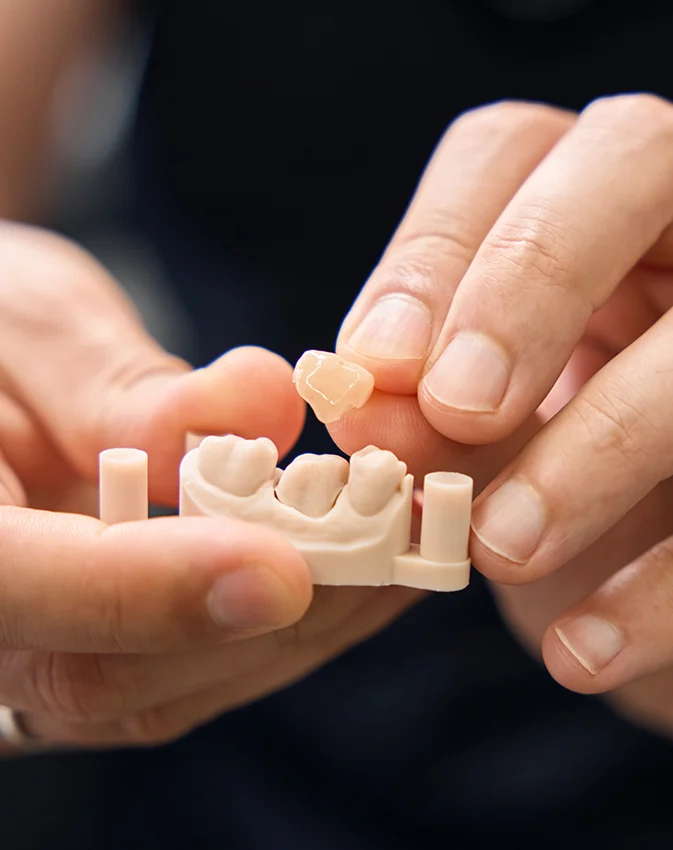

Get your smile back
Dental Crowns and dental onlays are done on teeth where fillings are not able to do the job. When fillings reach an overly large size, the physical properties of the materials and adhesives holding them together are overcome, and teeth tend to break even under normal function. Crowns and onlays can be thought of as “helmets” for teeth, offering them protection from bite forces. They not only restore teeth to function and increase the strength of weakened teeth, the current materials look great! A well-done crown is often indistinguishable from a natural tooth.
We have added Glass Ionomer sealants to our inventory! This class of material has been around for a long time, and has the ability to capture and release fluoride directly onto the teeth. In effect, one can think of them as a “rechargeable battery” for fluoride. When the sealants wear out (just like driveway sealant), glass ionomers leave behind a more decay-resistant tooth. This is compared to the more widely used resin sealants, which may stick better but can allow for more microleakage (and subsequent decay underneath).
Fast facts

Dental crowns are used to restore the original shape, size, and function of damaged teeth.
When placed, they can be expected to provide 2-3 decades of service.
With new materials and cements, crowns and onlays are much less invasive than ever before.
While they can sometimes be done after a fracture, the best time to do crowns or onlays is before they break!
The process

Step One
We assess the broken or at-risk-to-be-broken tooth to ensure a crown or onlay is the right solution. Photos and X-ray are taken, and estimates are given.

Step Two
We prepare the tooth by first reducing its size to make room for the crown. An impression of the tooth is taken and sent for fabrication, and a temporary crown is made to protect the tooth until the next appointment.

Step Three
When the final crown is ready, the temporary crown is removed, the tooth properly cleaned, and the final crown is cemented using the best cement for the situation.
Let the results speak for themselves
Looking for real life transformations? Take a look at some before and after examples.
See our other restorative
dentistry services
Try our virtual smile simulation
Crowns & Onlays FAQs
How much does a dental crown cost?
Dental crown cost is dependent on two factors: our clinical fee (which may include a foundation buildup), and the laboratory fee required to fabricate the restoration. Contact us to find our current crown fees.
How long is the procedure?
The crown process involves two appointments (for the time being). The first appointment (preparation) will take anywhere from 1 to 1.5 hours, and the second (insertion) will take about 40min to cement the crown.
How long will my dental crown last?
We can’t quote a definitive lifespan, but the literature suggests that after 20 years, 80% of crowns are still in service!
Does my insurance cover crowns and onlays?
This very much depends on your insurance policy. Some plans do not cover crowns, others provide 50% coverage, and others still will cover 100% with no yearly limit.
What is a dental crown made of?
So many options nowadays! Currently our most frequently-used crown materials are ceramic (lithium disilicate or zirconia), but the good ol’ gold or porcelain-fused-to-metal (porcelain on a metal foundation) still have their applications. Whenever we select a material, we have to balance aesthetics (front teeth more crucial obviously), load (grinders, opposing teeth), environment (oral hygiene, oral acidity) and bondability (some teeth are better served with minimally-invasive held in mainly by the cement, and others are less crucially dependent on the cement.

What Our Patients Say
See what patients in Barrie are saying about their experience with Dr. Elston Wong Dentistry.
Barrie, ON L4N 9E7