



Dental Implants at Dr. Elston Wong Dentistry
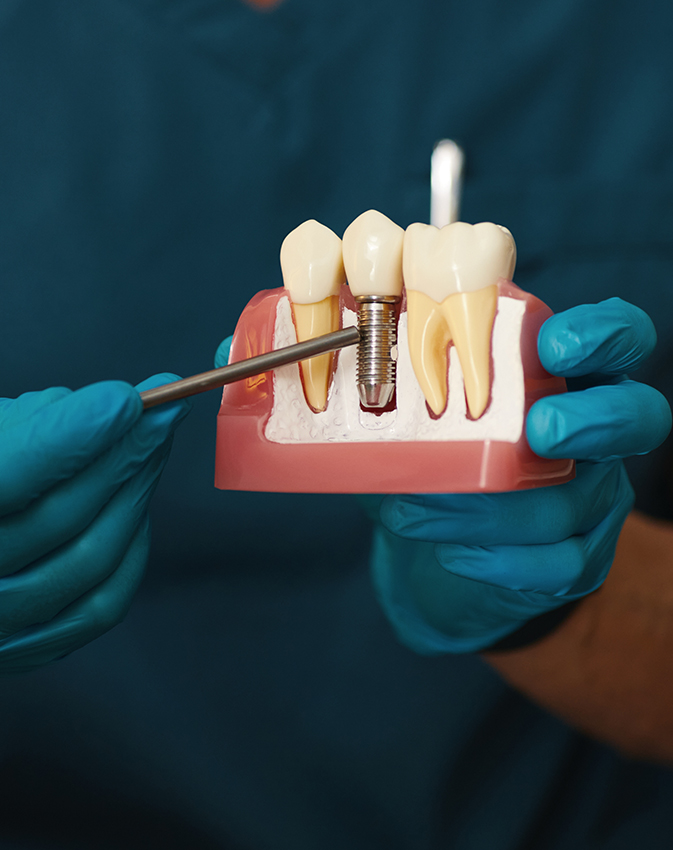

The state-of-the-art replacement for missing teeth
Implants are one of three ways we handle missing teeth. Along with bridges and dentures, implants are methods to replace teeth that feel great, work great, look great, and are also long-lasting. In general, dental implants are the longest-lasting tooth replacement. When replacing a single tooth, titanium posts are placed into the bone, and a tooth is then attached to that post. Unlike bridges and most dentures, implants don’t require damaging other teeth, and they prevent the bone around them from resorbing further (which happens when teeth are lost). They even allow for easy flossing between teeth (unlike bridges where floss must be passed underneath, or dentures which must be removed).
Like anything else in dentistry and medicine, one size never fits all – for some people and certain anatomical sites, implants are actually not possible nor preferred. Biology is complicated; our job is to help you find your way through the options.
Fast facts

When teeth are lost, the bone will shrink. Implants help stop bone loss.
Implants are intended to last for the long term, and the evidence bears that out.
Implants can be made to look like completely natural teeth.
Full mouth dental implants may allow an entire arch of missing teeth to be supported by as few as four to six implants.
The process

Step One
Workup: prior to placing an implant, we assess the available space and bone volume. This is done with digital scans as well as photographs and a Cone-beam CT scan.

Step Two
Implant(s) are placed! This can be done quite quickly for single implants, usually under local anesthesia only. A temporary prosthesis is given in areas where aesthetics is important.

Step Three
After a healing period of four to six months, the implant is ready to have a tooth or other prosthesis attached!
Let the results speak for themselves
Looking for real life transformations? Take a look at some before and after examples.
See our other restorative
dentistry services
Try our virtual smile simulation
Dental Implants FAQs
What are the effects when a tooth is lost?
When any tooth is lost, the bone around it rapidly starts to resorb. In cases where there is not usually much bone to begin with (upper and lower front teeth, we’re looking at you), this makes it very difficult to place implants in the future without bone grafting. Where this is a risk, placement of an implant immediately after extraction is a good idea.
How long does a dental implant take to complete?
Like every other answer you’ll see here, it depends. Think of implants as a two-part process: the first step (surgical phase) is to have an implant to integrate successfully into the bone, which can take anywhere from three to six months. After this, the second step (prosthetic phase) can take as little as two weeks, or in the case of more complicated reconstructions, several more months as things are worked out. The nice part? Once an implant is successfully integrated, you can take your time in attaching prostheses to it. It’s not going anywhere!
What are the benefits of dental implants?
Oh, so many. With dental implants, being anchored into the bone means that we can replace teeth without damage or risk to adjacent teeth (unlike bridges, or many partial dentures). Once inserted, implants are very versatile! They can be used to support individual teeth, bridges, dentures of many different designs!
Is there a lot of maintenance with a dental implant?
No more than a natural tooth. Although nothing is perfect, a successfully-placed implant simply needs regular hygiene at home (brushing, rinsing, and flossing or Waterpiking).
Does my insurance cover dental implants?
This really depends on the wording of your individual insurance policy. The best way to check would be to send an estimate in advance! We can help submit the required paperwork, and further appeals / clarification if they seem to deny coverage based on nonsense reasons (as has been known to happen).

What Our Patients Say
See what patients in Barrie are saying about their experience with Dr. Elston Wong Dentistry.
Barrie, ON L4N 9E7