



Sealants at Dr. Elston Wong Dentistry
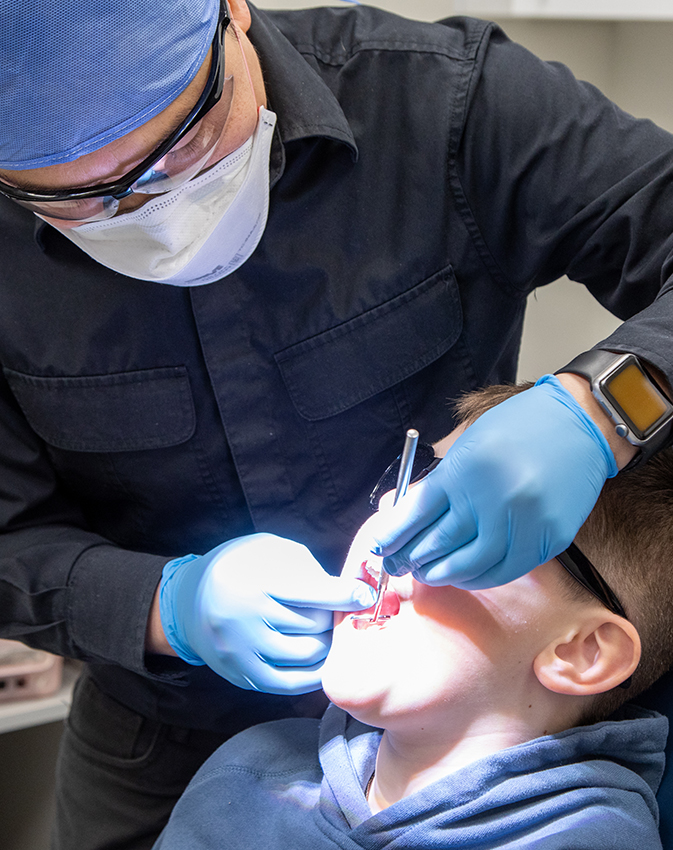

Decay prevention for hard to reach places
Did you know that decay in the grooves of teeth is the most difficult type of decay to prevent? This is due to food and bacteria packing deep into the grooves, and since the grooves are so narrow, this food is impossible to clean out. If we can, we try to seal the grooves before decay develops. Dental Sealants are typically applied on children’s teeth when they emerge sufficiently into the mouth.
We have added Glass Ionomer sealants to our inventory! This class of material has been around for a long time, and has the ability to capture and release fluoride directly onto the teeth. In effect, one can think of them as a “rechargeable battery” for fluoride. When the sealants wear out (just like driveway sealant), glass ionomers leave behind a more decay-resistant tooth. This is compared to the more widely used resin sealants, which may stick better but can allow for more microleakage (and subsequent decay underneath).
Fast facts

Sealants are a noninvasive, painless way of preventing decay in the grooves of teeth.
Applying the sealants takes just a few minutes per mouth. No anesthesia required.
Sealants are a great evidence-backed method for preventing pit and fissure decay in permanent molars.
For added protection, Silver Diamine Fluoride (SDF) can be added to the tooth before sealing.
The process

Step One
The tooth to be sealed is cleaned mechanically with an air abrasion device (think sandblaster) to clean plaque off the surface.

Step Two
The tooth surface is then cleaned chemically with an acid solution.

Step Three
The actual sealant material is applied! The sealant is set before the patient leaves the office with instructions not to eat for 30 minutes afterwards.
Let the results speak for themselves
Looking for real life transformations? Take a look at some before and after examples.
See our other preventive
dentistry services
Try our virtual smile simulation
Sealants FAQs
Who can get dental sealants?
Dental sealants are suitable for any age, but are most beneficial on permanent molars with deep grooves when the teeth are just new into the mouth. At that age, the enamel has not been exposed to as much fluoride and as such is more susceptible to decay.
Are dental sealants painful?
Absolutely not! They are done without any local anesthetic.
How long do dental sealants last?
Dental sealants can be thought of like driveway sealer – at some point everything wears away and may need re-sealing. We only re-seal teeth when the previous sealant has worn down enough, which is usually once every three or four years.
How effective are dental sealants?
A common misconception is that sealants create a magical shrink-wrap barrier to decay all around the tooth. In reality, sealants are made to seal the grooves and pits of teeth where bacteria and food are likely to penetrate but are not easily cleansable. The Canadian Dental Association supports the use of dental pit and fissure sealants as an effective preventive measure.
Do dental sealants mean I don’t have to brush anymore?
The sarcastic answer would be “Sure, go ahead and see how that works out for you.” The real answer: no. Sealants are only for prevention of decay in the grooves of back teeth. They are not present on front teeth nor are they anywhere other than the biting surfaces of back teeth. All of those surfaces still need to be kept clean with oral hygiene measures.
When can my child get a dental sealant?
The optimal recommended time is within the first four years of a tooth’s appearance in the mouth, but even better would be as soon as a tooth can be satisfactorily kept clean for a sealant to be applied.
What do sealants look like?
Sealants can be clear, white, or in some cases, even light pink. Regardless of the brand, sealants are not typically visible to the causal eye.

What Our Patients Say
See what patients in Barrie are saying about their experience with Dr. Elston Wong Dentistry.
Barrie, ON L4N 9E7